
Last week, I was talking to a client who asked for advice about an employee. While the employee was getting good results within their discipline, there were doubts about how this person fit in with the rest of the team.
Several people had experienced friction in their cooperation with this person, but my client wasn’t sure whether this was normal friction in a new work relationship or something else. Plus, this person brought a much needed perspective to the team that everyone else was simply less used to. So they also considered that, maybe, the rest of the team would simply have to get used to this person thinking and working differently.
Whenever clients tell me about people on their team that are causing friction, the first thing I check with them is whether this is the Right Person for the studio, and if they are in the Right Seat. This concept comes from business author and researcher Jim Collins, who says that every company should track the percentage of right people in the right seat (RPRS).
But how do you do that?
Right Person
Whether or not someone is the Right Person for your studio depends on the degree to which they can fit into and contribute to your studio culture. Rather than some vague “this is how we do things” vibe, studio culture can be dependably codified into a set of Core Values, which I’ve written about previously here, and here.
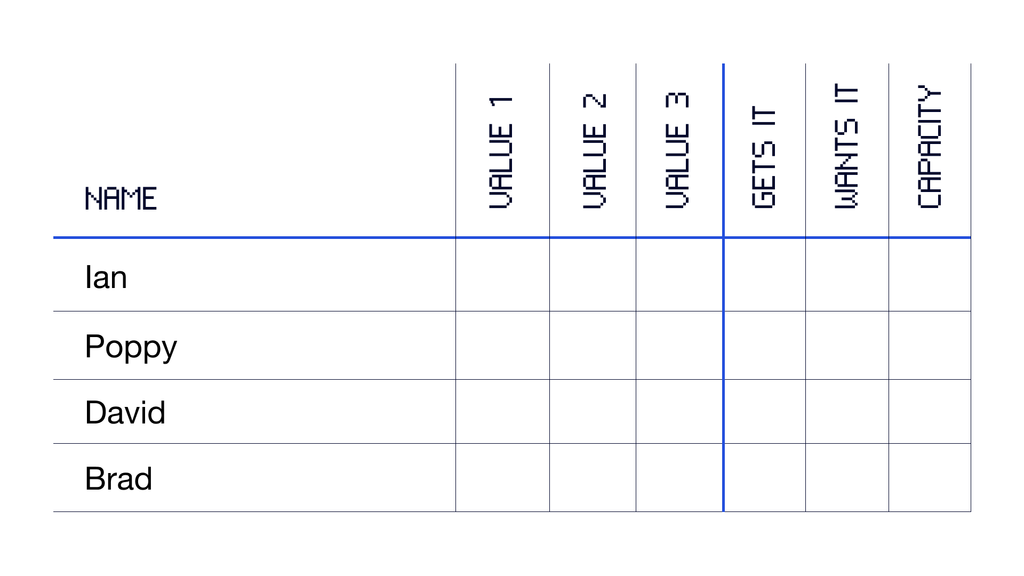
To check for culture match, rank each person on your team on the degree to which they exhibit your core values. They either exhibit a value “often” (+), “sometimes” (+/-), or “not often enough” (-). You want each person to score a (+) on about 2/3rds of your core values, and (+/-) on the rest. There should be no (-) scores.
If someone clears that bar, they are a good fit for your studio culture. If they do not, you’ll want to act on this quickly to prevent them from causing friction with the rest of the team and diluting your studio culture.
When there are too many (+/-) scores or any (-) scores, this should trigger a conversation about how they plan to live up to the studio values in the future. And if someone fails to improve, a simple 3 strikes rule prevents you from keeping a bad fit on board longer than you should.
In the case of my client, we quickly determined that the problematic employee was a poor match for 4 out of 6 studio values. This was an important realization, as it instantly made clear where my client’s uncomfortable gut feeling was coming from. This person wasn’t just causing friction by doing things differently than everyone was used to; their behavior was going against the core values at the heart of their studio.
Right Seat
Going beyond culture match, we can also check if a person is in the Right Seat. To do so, you first have to have a clear picture of the role this person will fulfill, and what processes and outcomes they will be accountable for. If you have that, you can evaluate the role match against three simple criteria:
- Does this person get what is needed to succeed in this role?
- Does this person truly want everything that comes with this role, the good and the bad?
- Does this person have the capacity to succeed in this role?
A person is not a good fit for the seat until they can check each of the three criteria: they have to get it, want it, and have the capacity to do it.
In the case of my client, there was no doubt that their employee knew how to succeed, and they clearly had the capacity to do so. They had, however, explicitly stated that they were not interested in the checks and balances the studio had put on their output, because they felt it would slow them down. In other words, this person did not want to fill the role in the manner that was expected of them. One more reason for my client to have a serious conversation with them.
Getting RPRS right at your studio
While this approach may seem straightforward, many studios fail to evaluate people in their team on these criteria. This often allows bad apples to stay on for too long, causing unnecessary friction.
Don’t be that studio! Keeping track of the degree to which you have RPRS’d your studio is as simple as grabbing the template below, and filling it in:
Now that you know this approach, you can use it to make sure that all your people are the right people, and that they’re in the right seat. Especially if someone is causing friction, and you can’t put your finger on the issue.
Getting the right people in the right seats is just one of the things I help my clients with. Subscribe to The Long Game for more insights form my coaching work, delivered directly to your inbox