
In The Five Dysfunctions of a Team, Patrick Lencioni argues that trust is the foundation of superior team performance.
A team that trusts each other is better at navigating conflicts in a productive manner. Through productive conflict, these teams ensure that everyone is heard, and foster commitment to the eventual outcome. When teams commit in this way, they take accountability in a way that is simply impossible when people feel like they have been passed over. And when teams share a sense of accountability, they tend to put shared goals over personal goals that might derail the greater good.
In an earlier essay, I’ve suggested an exercise that teams can use to build trust together.
Today, I want to give you a tool that you can use to get a more granular view of your trust levels with those around you: the Trust Equation.
The Trust Equation
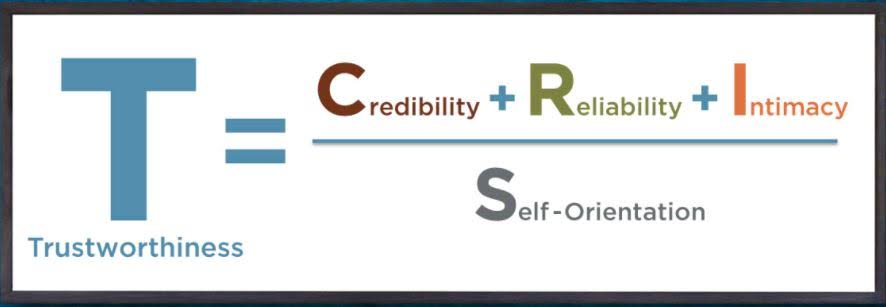
The Trust Equation comes from the book The Trusted Advisor by David Maister. In the book, Maister argues that trustworthiness is actually a compound, made up of four distinct facets:
Let’s look at the individual elements first:
Credibility (C): Relates to the words we speak and our perceived expertise or credentials.
Reliability (R): Relates to our actions, consistency, and whether we do what we promise.
Intimacy (I): Relates to the emotional safety and security others feel when sharing information with us. My colleagues at Valued Cultures prefer to call this Relatability, to emphasize that this is really about relating to your coworkers as a human being, more so than having to become best friends, or sharing personal details that you might not feel comfortable sharing.
Self-Orientation (S): The denominator representing how much focus is placed on oneself rather than the other person.
Second, let’s look at each element’s orientation in the equation.
Credibility, Reliability and Intimacy are all positioned above the fraction bar, meaning that a higher score here all add to higher levels of trust.
Self-Orientation, meanwhile, is positioned below the fraction bar, meaning that a high score here will wipe out your trust levels even if you score high on the other three elements.
I think it’s important to note that I’m not convinced that this equation captures a mathematical truth about trust. Rather, I think this captures a psychological truth about trust, which just so happens to present nicely as a mathematical equation. If we can accept this, then we can use this tool to unpack the trust levels we’ve built with the people around us.
Using the Trust Equation
In my work with studios, I suggest two main use cases for this tool:
- Gauging how much the people you work with trust you, and why
- Gauging how much you trust the people you work with, and why
Especially as someone in a leadership position, you want to be aware of both perspectives, and invest in building up the levels of trust in the relationship.
Here’s how to go about it.
For any relationship, first consider how much trustworthiness you have demonstrated to that person. Give each element a number between 1 and 5, and reflect on the results. Again, more than the final number, the insight is in unpacking the different facets of trust, and showing you where improvements might be needed to increase your overall trust level.
- Low on credibility? Set some time aside to brush up on your knowledge
- Low on reliability? Send a deliverable early and ask for feedback
- Low on relatability? Set a coffee meeting with “no work talk” stipulation
- High on self-orientation? Offer to “take one for the team” at the next opportunity
Second, we can also use gauge how trustworthy the other person seems to us. Fill in the equation once more, but this time for how you see them. The value in doing this is that, even if this concerns another person, you should now have a clearer idea of what they can do to earn your trust. And once you know this, you can simply ask them to do that.
Even though trust is a two-way street, this tool gives you actionable starting points to influence that trust in both directions.
Try it out
If you want to give this tool a try for yourself, start here:
- Pick a work relationship that is currently strained.
- Fill in how that person might see you, rating each element from 1-5. Pick the lowest element, and come up with one thing you can do to improve that score in the eyes of the other person.
- Fill in how you see the other person. Pick the lowest element, and come up with one thing you can ask this person to do that would improve their score for that element.
It should go without saying that this works best if everyone on the team takes responsibility for building trust in this way. But even one person can start to make a difference. Why not be that person?